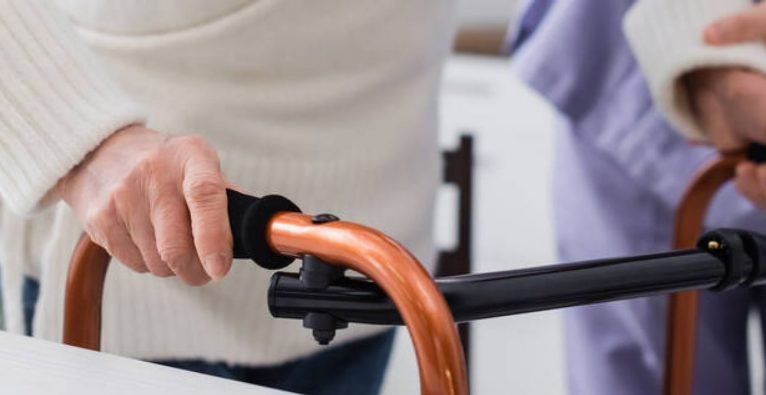
A walking frame only works if the handles sit at the right height and the frame will pass your doors. Measure those two things before you order a Zimmer frame or a rollator. This page shows how, and lists the widths and handle ranges makers print on a few common UK models.
Key takeaways
- Stand in the shoes you will walk in. Measure from the crease of your wrist straight down to the floor. That is the handle height to aim for.
- Measure the gap with every door open, not the hole in the wall. Compare that with the maker’s overall width, and leave a little for knuckles and bags.
- Pick a handle range where your measurement sits near the middle, not on the last hole. If you are tall, check the top of the range before you choose a narrower frame.
- Three wheels does not mean a narrower frame. Compare the number on the spec sheet.
- The NHS notes that height matters, and that you can sometimes borrow a frame after an assessment. See NHS guidance on walking aids. A shop can set the height with you. This page does not replace that.
Handle height
Stand in the shoes you will walk in, arms relaxed by your sides. Measure from the crease of your wrist (where a watch sits) straight down to the floor. That number is the handle height to aim for. When you hold the grips, elbows should be slightly bent, not locked and not shrugged.
Pick a frame whose stated range has your measurement near the middle, not on the last hole. Drive’s folding Zimmer frames (WA008 without wheels, WA009 with front wheels) both list handles 81–99 cm. Homecraft’s four-wheel rollator in our rollator guide tops out at 90 cm. The Drive R8 rollator goes to 97 cm. If you are tall, check the top of the range before you fall in love with a narrower frame.
Getting up from a chair is a different check. You should be able to push up without the frame shooting backwards. If you cannot, you need a different aid or someone with you — not a lower handle “to make it easier”.
Width and doors
Measure the clear opening: the gap with the door open, from stop to door face, at the height the frame will pass. Ignore the hole in the wall. Then compare that with the maker’s overall width, and allow a little for knuckles and bags.
Overall width is not the gap between the handgrips. On a Zimmer it is usually the widest point of the side legs. On a rollator it is often the wheels or the bag.
Drive folding Zimmer, no wheels (WA008)
Narrower indoor frame
- Overall width
- 55 cm
- Handles
- 81–99 cm
- Frame weight
- 2.9 kg
- User limit
- 180 kg
Drive folding Zimmer, front wheels (WA009)
Wider, you push rather than lift
- Overall width
- 62 cm
- Handles
- 81–99 cm
- Frame weight
- 3.4 kg
- User limit
- 180 kg
Drive three-wheel rollator (TW008)
Three wheels, no seat
- Overall width
- 66 cm
- Handles
- 83–94 cm
- What you lift
- 4.7 kg with bag
- User limit
- 125 kg
Homecraft four-wheel rollator
Four wheels, rest seat
- Overall width
- 60.5 cm
- Handles
- 78–90 cm
- What you lift
- 6.8 kg
- User limit
- 160 kg
A three-wheel rollator is not automatically the one that fits a narrow hall. Drive’s three-wheel is listed at 66 cm, wider than their narrower Zimmer. Compare the number, not the wheel count. Full choices: Zimmer frames and rollators.
Length, turning and the car
A frame also has a front-to-back length. You need space to step into a Zimmer, and space to turn a rollator at the end of a landing. If the hall is a tight L-shape, take both measurements to the shop.
If it has to go in the car, ask how thick it is folded, and whether the weight includes the bag. Some rollators look lighter on paper because the bag has been taken off. Try the fold with the hands that will lift it into the boot.
User weight
Stay inside the maker’s user limit. Drive’s folding Zimmers list 180 kg. The rollators above are 125–160 kg. The limit is for the person using the frame, not the frame plus shopping.
Check before you order
- Wrist-to-floor in usual shoes, in centimetres.
- Clear opening of every door the frame must pass.
- Maker’s overall width and handle range for the exact model.
- Folded size and the weight you will lift.
- User limit.
- That someone can set the height with you if you are unsure on balance.